
The Irish Poor Law Act, 1838
Passed seven years before the blight. Ireland had had no national system of poor relief at all before this, unlike England, which had operated one since 1601. Relief in Ireland had been a matter of charity, the churches, and whatever a landlord chose to do.
How it worked
In 1838 the country was divided into 130 Poor Law Unions, increased to 163 by 1850. Each union centred on a market town and took in the surrounding countryside, cutting across county and parish boundaries. Each was required to build and run a workhouse, and was divided into electoral divisions made up of groups of townlands, which elected the Guardians and paid the poor rate.
Valuers went holding by holding and set a yearly value on every piece of land and every house, based on what it could reasonably be let for. That figure went into a rate book listing the occupier, the landlord, and the valuation. The Guardians estimated what the union would need and struck a rate, so many shillings and pence in the pound, charged division by division according to the paupers each one sent to the workhouse. The occupier paid, but could deduct half from his rent. From 1843, on holdings valued at £4 or less, the landlord paid the whole rate.
All of it went to the union to run the workhouse and, from 1847, outdoor relief.
Example
A division owes £500 and its total valuation is £5,000. That’s 2 shillings in the pound. A landlord whose estate in that division is valued at £2,000 is looking at £200 of the bill, paid partly by himself and partly by his larger tenants, depending on how the land was let.
£500 ÷ £5,000 = 0.1, and a tenth of a pound is 2 shillings (20 shillings to the pound). So 2s in the pound.
£2,000 × 2s = £200.
What the tenant pays
A tenant on a holding valued at £10, paying a rent of £12:
To the poor rate collector: £10 × 2s = £1 (20s).
To the land agent: his rent minus 10s (half the poor rate), so £11 10s.
In total: £12 10s, of which 10s is his share of the rate.
NB. Smallholders on £4 or less were spared the poor rate itself (the landlord paid it in full), but still owed their rent.
The incentive to clear the land
Nowhere was this worse than in the West of Ireland. Generations of subdivision had left families on a few acres of bog and rock, growing little but potatoes, with no linen trade or other work to fall back on. Land values were low and pauperism high, so western divisions had to raise large sums from a small base, and their rates climbed fastest. When the potato failed, the people on the smallest holdings had nothing else, and they were exactly the tenants the landlord was paying for.
Eviction did not free him from the cost. A family turned off the land usually ended up in the workhouse, and their keep went straight back onto the rate for the division they came from. The landlord was still paying for them, only now through the Guardians instead of on the holding. What eviction did was clear the ground for the future: fewer smallholders, larger farms let to tenants who paid half their own rate, and in time a lower bill.
***Eviction did not end a landlord’s costs; it spread them. Once his former tenants were in the workhouse, their keep was charged to the whole division, so he paid only his share of it. The rest fell on his neighbours, and beyond them on the union, the Rate-in-Aid and the Treasury***
This was a greater incentive for eviction
The cheapest course in the long run was to be rid of them altogether, and that meant paying their passage abroad. Some landlords shipped tenants to Canada because a fare cost less than a year of keeping them in the workhouse. The most notorious was Lord Palmerston, then Foreign Secretary, whose agents cleared his estates in North Sligo in 1847. Over that summer and autumn nine ships carried more than 2,000 of his tenants from Sligo port. Many reached Saint John, New Brunswick, late in the year, half-clothed and destitute, and the city had to take them into care. Its Common Council wrote to Palmerston in protest at his sending so many of his tenants to face a New Brunswick winter.¹
The Gregory Clause of 1847 helped the process along: anyone holding more than a quarter acre was refused relief, so starving tenants gave up their land to get food.
The burden broke many landlords too. With tenants unable to pay rent and rates rising, estates fell into debt, and the Encumbered Estates Act of 1849 forced the sale of hundreds of them, often to new owners who cleared the land more ruthlessly than the old.
¹ Tyler Anbinder, “Lord Palmerston and the Irish Famine Emigration”, The Historical Journal, 44:2 (2001), pp. 441–469.
Many Poor Law unions in Connacht went bankrupt. Plenty of landlords did too, and the Encumbered Estates Act of 1849 sold their land on, often to buyers who cleared it further. Resentment also turned violent: Major Denis Mahon of Strokestown, Roscommon, was shot in November 1847 after clearing and shipping out his tenants.
The Illustrated London News chose Kilrush. Co Clare in December 1849 to show its readers what the Poor Law meant in practice. The union had run out of money and credit; the dead were buried without coffins, and families evicted from the surrounding estates lived in scalpeens dug into the ruins of their own homes. The chairman of the Guardians was Colonel Vandeleur, whose family owned the town and cleared the land around it.
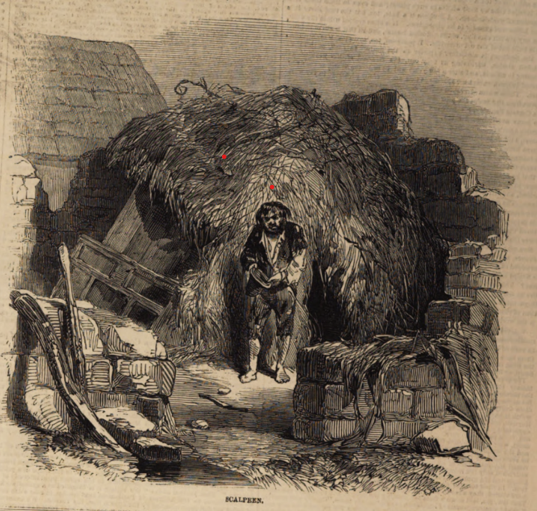
Scalpeen, Kilrush Union, Co. Clare. A shelter built by an evicted family in the ruins of their home. Illustrated London News, 15 December 1849, p. 393.
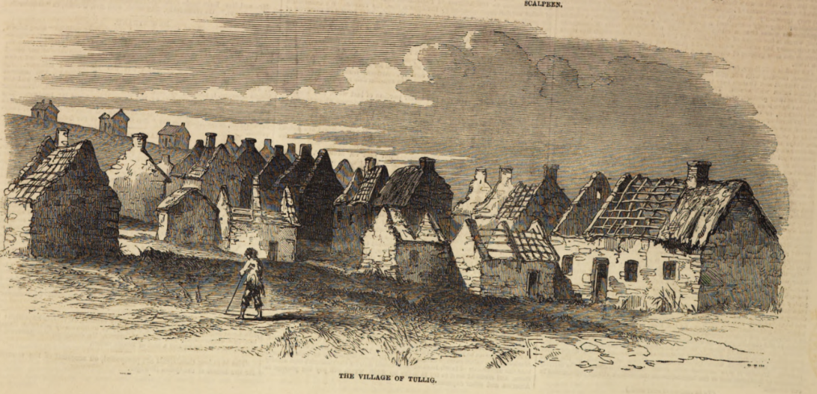
The Village of Tullig, near Kilkee, Kilrush Union, Co. Clare. Cleared and unroofed after the evictions; on the road from Kilkee to Tullig the ILN’s correspondent counted ninety-two roofless houses. Illustrated London News, 15 December 1849, p. 393.
The Government knew. Captain Arthur Kennedy, Poor Law Inspector at Kilrush, reported some 15,000 people evicted in a year, with 20,000 more homes marked for destruction. His figures were read in the Commons in June 1849. Parliament changed nothing.
Poor Law Extension
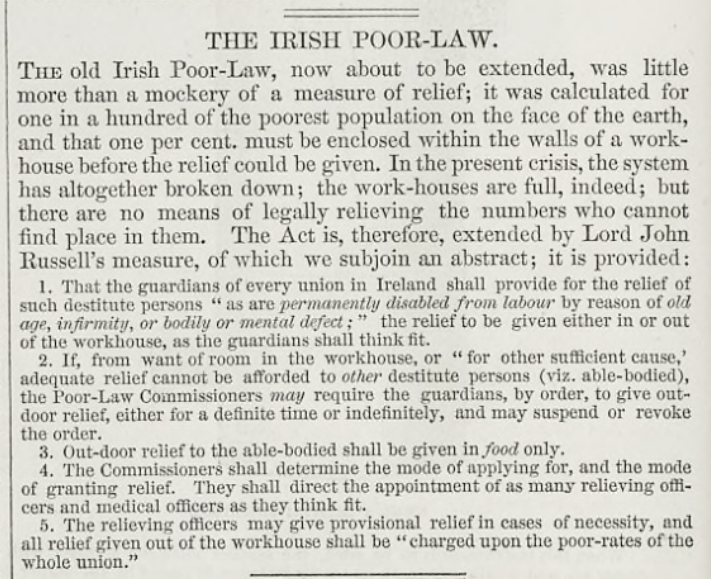
This is the Ilustrated London News summary of Lord Russell’s Poor Law Extension Bill, Jan, 30, 1847. It was introduced in January, passed as the Poor Relief (Ireland) Act in June 1847, and took full effect in autumn 1847, when the soup kitchens closed. What the new law did, point by point:
The old, sick and disabled (“permanently disabled from labour by reason of old age, infirmity, or bodily or mental defect”) now had a right to relief, inside or outside the workhouse.
The able-bodied could get relief outside the workhouse only if the workhouse was full, and only if the Poor Law Commissioners ordered it. It was at their discretion, and could be stopped.
That outdoor relief for the able-bodied was food only. No money.
The Commissioners decided how relief was given, and appointed relieving officers and doctors.
Relieving officers could give emergency relief, and all relief outside the workhouse was charged to the local poor rates.