
An Gorta Mór
THE GREAT HUNGER · IRELAND 1845–1852
This novel is rooted in history. These are the facts that made it necessary. They are not background.
They are the ground itself.
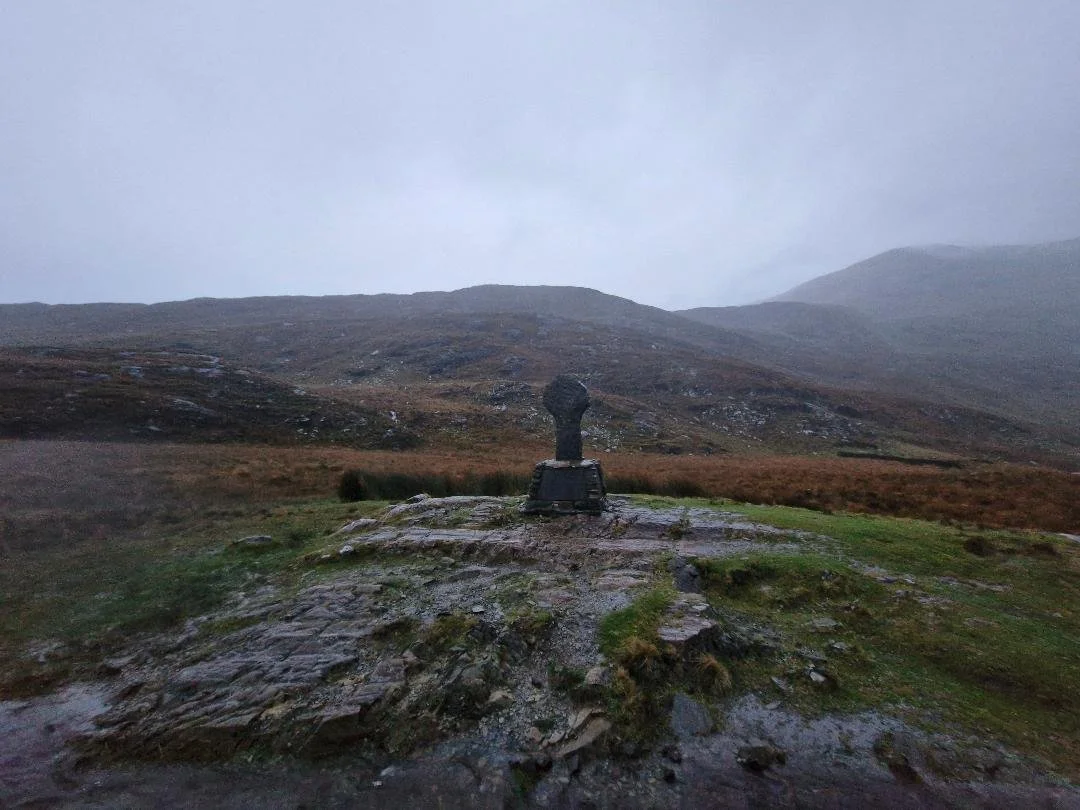
Doolough Valley, Co. Mayo · Photograph by the author
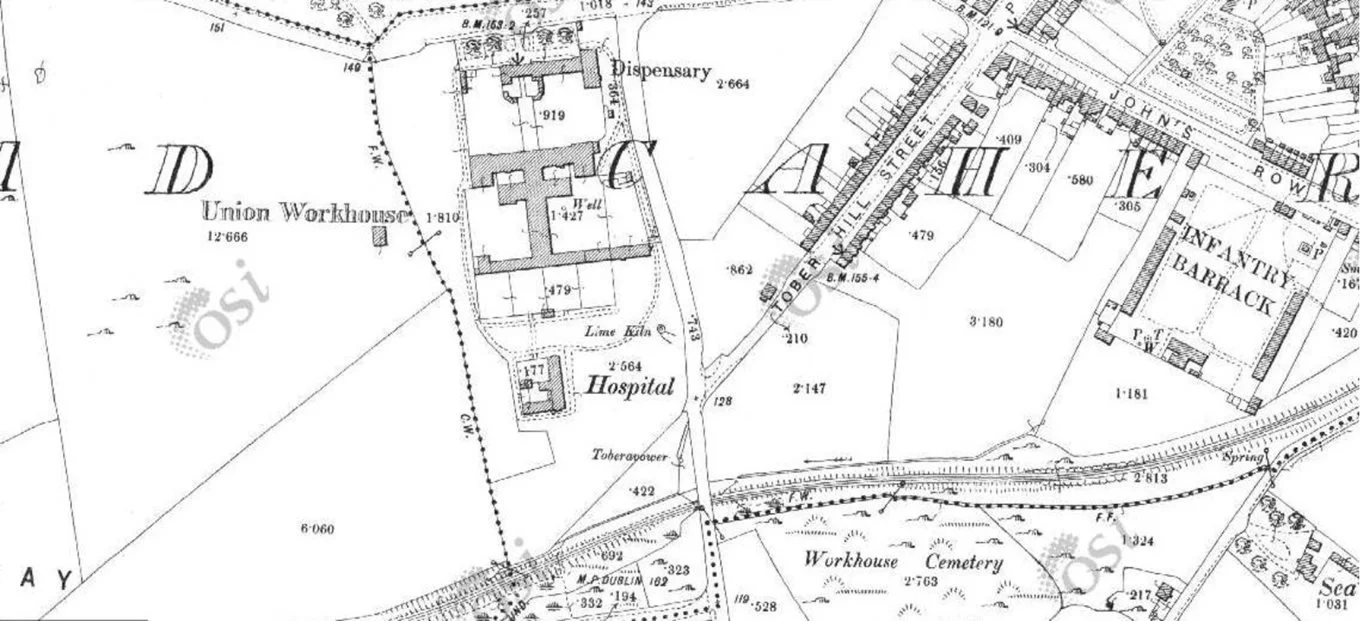
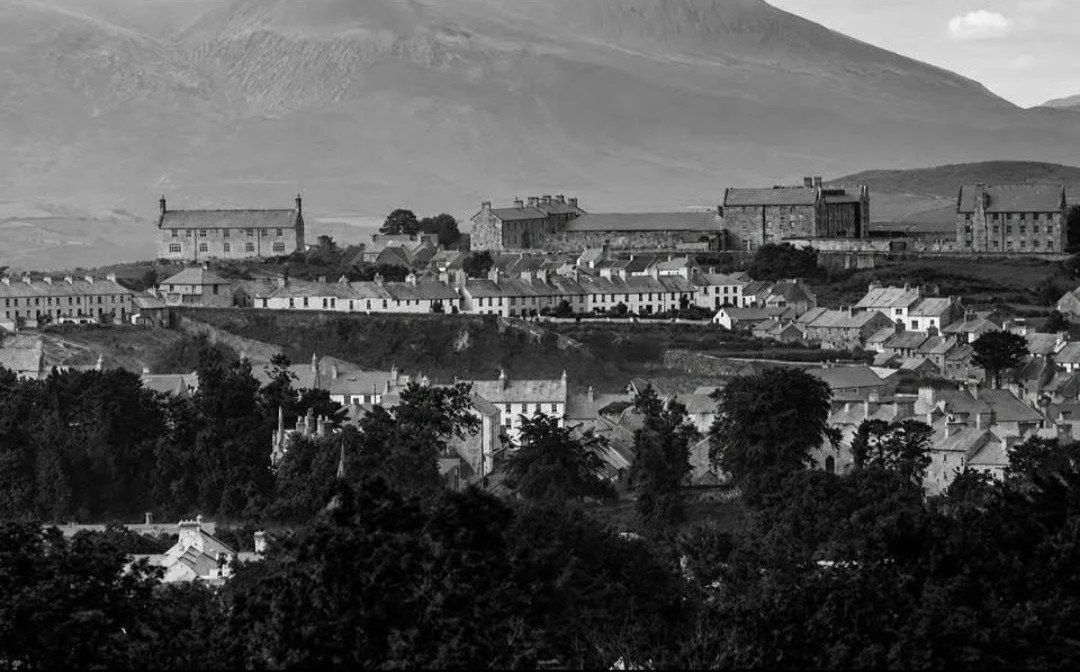
The old Barracks and Workhouse in Westport pre 1900
Photo Eddie Stone
I am English. I have no claim on this history except the one anyone has who stands before it and cannot look away.
I have no dúchas here. But I have listened to those close to me for whom this is not mere history but in their blood.
The Blight.
The crisis was triggered by potato blight (Phytophthora infestans), a water mold that repeatedly destroyed Ireland's primary food source. It originated in the highlands of central Mexico and spread to North America and then to Europe in the 1840s, arriving in Ireland in 1845. It thrived in cool, wet conditions, which made the Irish climate ideal for its spread.
1845: The blight arrives from North America, wiping out roughly half of the year's potato crop.
1846: The crop failure is near-total, causing widespread starvation to take hold over the winter.
1847 ("Black '47"): The absolute worst year of the crisis. While the blight itself briefly relented, desperate farmers hadn't been able to plant enough seed potatoes. Mass starvation, hypothermia, and typhus devastated the population.
1848–1849: The blight returns with a vengeance, causing successive crop failures and prolonged suffering.
1852: The famine finally draws to a close as the agricultural yields begin to stabilize, though the societal scars remain permanent.
The Scale of the Catastrophe.
Between 1845 and 1852, approximately one million people died of starvation and disease in Ireland. Another million emigrated. Mayo lost more than a quarter of its population. Connacht was the worst hit province in Ireland. Mayo and Roscommon suffered most severely of all.
Alongside this human devastation, the Irish language (Gaeilge) suffered a catastrophic, near-fatal collapse.
Source: Census of Ireland 1851; Cormac Ó Gráda, Black '47 and Beyond (1999). The Census of Ireland for the Year 1851 (British Parliamentary Papers, published 1855)
In 1845 the population of Ireland was approximately eight million. By 1900 it was half that. Ireland remains the only country in Europe with a smaller population today than it had in the mid-nineteenth century.
Source: Census of Ireland 1851; Cormac Ó Gráda, Ireland Before and After the Famine (1993)
The Westport Workhouse
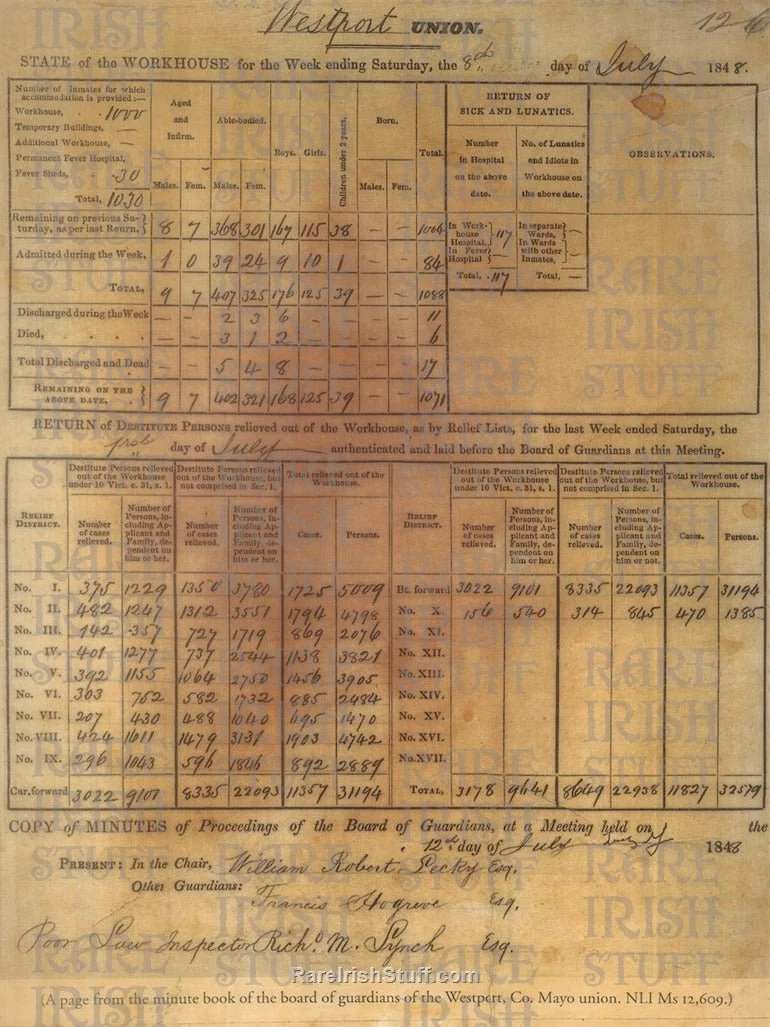
In 1844, a warship and two cruisers sailed into Clew Bay, not to bring relief, but to collect the poor rate from a starving population. The workhouse finally opened on 5th November 1845. The blight had arrived that same year. When both nurses fell ill, the Medical Officer was instructed to select two intelligent paupers from among the inmates to perform the nurses duties. One November week in 1848: 1,000 people held inside the workhouse. 30 in the fever sheds. 112 in the infirmary. 700 in an auxiliary workhouse nearby. 1,842 human beings. Counted. Recorded.
Source: Westport Union Workhouse Record-Book, 1848, Westport Historical Society
The Doolough Tragedy. In March 1849, six hundred starving people walked through a Mayo blizzard to Delphi Lodge, where the Poor Law Guardians were meeting. The Guardians made them wait outside in the cold while they finished their meal. Then they refused them relief and sent them home. Many died on the road back through the Doolough Pass. The number was never recorded
Source: Sheila Mulloy, local Famine records; Doolough Famine Walk Commemoration, Gerard Mac Mathúna, The Doolough Tragedy (2001)
The Politics.
An Gorta Mór was not simply a natural disaster. The potato blight was the trigger. British government policy was the cause.
At the height of the Famine, Ireland was exporting food. In 1847 alone, vast quantities of grain, cattle, and butter left Irish ports under armed guard while people starved on the roadsides outside.
Source: John Kelly, The Graves Are Walking (2012)
Charles Trevelyan, the British civil servant responsible for Famine relief, described the catastrophe as the judgement of God on an indolent and unself-reliant people. He was knighted in 1848.
Source: Tim Pat Coogan, The Famine Plot (2012)
The Poor Law Extension Act of 1847 made starving tenants ineligible for relief if they held more than a quarter acre of land. To eat, they had to surrender everything. Landlords evicted hundreds of thousands.
Mayo lost more than a quarter of its population between 1841 and 1851. The evictions that drove that loss were so numerous and so poorly recorded that history cannot name them all.
The land agitation that followed did not end with the hunger. In 1880, a Mayo land agent named Captain Charles Boycott found his name entering the English language when the local community, organised through the Land League, refused all dealings with him. To boycott. One of the few Irish words English ever had to borrow, and it came from the fields of Mayo.
Source: Census of Ireland 1841 and 1851; John Kelly, The Graves Are Walking (2012); Cormac Ó Gráda, Black '47 and Beyond (1999); Poor Law Union records, Ballinrobe and Castlebar, Joyce Marlow, Captain Boycott and the Irish (1973)
The British government spent more money on the construction of Buckingham Palace than it did on Famine relief in Ireland.
Source: Tim Pat Coogan, The Famine Plot (2012)
The Catholic Church
The Catholic hierarchy was largely conservative and cautious during the Famine. Many bishops were reluctant to challenge British authority directly, fearing the consequences for the Catholic emancipation gains they had only recently won in 1829.
Source: Emmet Larkin, The Roman Catholic Church and the Creation of the Modern Irish State (1975); Desmond Bowen, The Protestant Crusade in Ireland (1978)
The Catholic Church was itself a landowner in Ireland. Some Church properties and revenues were protected during the Famine while tenants on surrounding land starved. This is rarely discussed in popular accounts of the period.
Source: S.J. Connolly, Priests and People in Pre-Famine Ireland (1982); Emmet Larkin, The Historical Dimensions of Irish Catholicism (1984)
The Church's response to Protestant proselytising during the Famine was often more concerned with the shame of conversion than with the suffering that drove people to it. The word Souper was wielded as a weapon by a Church that could not always feed its own people.
Source: Desmond Bowen, Souperism: Myth or Reality? (1970)
Archbishop John MacHale of Tuam, whose diocese covered much of Mayo and Connemara, was one of the few senior Catholic figures who publicly and repeatedly condemned British government policy during the Famine. He wrote directly to Prime Minister Russell demanding action. He was largely ignored by London and regarded with suspicion by Rome.
Source: Bernard O'Reilly, John MacHale, Archbishop of Tuam (1890); Nuala Costello, John MacHale (1939)
Beyond Pius IX's donation in 1847, the Vatican's engagement with the Famine was minimal. No formal condemnation of British policy was ever issued. The Catholic Church in Rome did not name what was happening in Ireland for what it was.
Source: Emmet Larkin, The Roman Catholic Church and the Creation of the Modern Irish State (1975)
The number of priests who died serving the people of Connacht during An Gorta Mór has never been fully recorded . In May 1847 alone, eighteen priests died of fever across Ireland. In Westport, Reverend Patrick Pounden died that same year, exhausted by his labours among the famishing and the dying. He was one of many.
When the hunger came, what little the Church held in these parishes, vessels, plate, whatever could be sold or pawned, was considered by some priests not as sacred property to be protected but as the last resource of a desperate people.
Source: Catholic Directory 1847; The Telegraph, April 1847; Daniel Grace, Priests Who Died in the Great Famine, Tipperary Studies, Historical diocesan records cited in Emmet Larkin, The Roman Catholic Church and the Creation of the Modern Irish State (1975); Archdiocesan Archives, Tuam
The Response
The British government's primary relief measure was the Public Works scheme, starving people were put to work building roads and breaking stones in exchange for wages too low to buy sufficient food. Many died at their work. The schemes were abandoned in 1847 and replaced with soup kitchens, which were themselves closed within months under pressure from laissez-faire economic doctrine.
Source: John Kelly, The Graves Are Walking (2012); Cormac Ó Gráda, Black '47 and Beyond (1999)
The total expenditure of the British government on Famine relief in Ireland between 1845 and 1850 was approximately £8 million, much of it issued as loans that Ireland was expected to repay. By comparison, £20 million had been paid in compensation to British slave owners when slavery was abolished in 1833. The enslaved received nothing.
Source: Christine Kinealy, This Great Calamity (1994)
In 1847, the Choctaw Nation of Native Americans sent $170 (Approx $8,000 today) to Famine relief in Ireland, when they had almost nothing themselves. They had themselves been forcibly displaced from their lands just sixteen years earlier on the Trail of Tears. They gave anyway, because they recognised in Ireland's suffering something they had survived themselves.
The Choctaw Nation in 1847 was led by Principal Chief Peter Pitchlynn — Ha-tchoc-tuck-nee, The Snapping Turtle, a man who had walked the Trail of Tears with his people and knew what it meant to watch a nation die. It was under his leadership that the decision to give was made.
In 1995 President Mary Robinson visited the Choctaw Nation in Oklahoma and presented them with a crystal bowl in recognition of their gift. It was the first formal acknowledgement by an Irish head of state.
In 2017, Irish people raised over $1 million for the Choctaw Nation during hardships. The debt repaid 170 years later.
Source: Arthur DeRosier, The Removal of the Choctaw Indians (1970); Choctaw Nation of Oklahoma historical records. Pitchlynn's precise role in authorising the Irish donation is not fully documented in all historical accounts.
The Ottoman Sultan Abdülmecid I attempted to send £10,000 to Ireland in 1847. Queen Victoria asked him to reduce it to £1,000, as she herself had only given £2,000. He sent the £1,000 officially. He is also said to have secretly sent three ships of food. The ships are said to have landed at Drogheda.
Source: Ottoman imperial archives; Christine Kinealy, This Great Calamity (1994). The food ships are recorded in Irish-Turkish cultural accounts but are not universally verified.
The Society of Friends, the Quakers, provided some of the most effective and least conditional relief during the Famine. They asked nothing of recipients. No religious conversion. No means test. They simply fed people.
Source: Transactions of the Central Relief Committee of the Society of Friends, 1852; (held in the Religious Society of Friends Library in Dublin). Rob Goodbody, A Suitable Channel: Quaker Relief in the Great Famine (1995)
Some Protestant relief organisations offered food and shelter on the condition of conversion. Those who converted to escape starvation were called soupers, a word that carried shame in Irish communities for generations.
Source: Dublin Diocesan Archives; Irish Church Missions records; Hansard Parliamentary Debates, 1846–1848; Desmond Bowen, Souperism: Myth or Reality? (1970); Irene Whelan, The Bible War in Ireland (2005)